AI-Powered Smart Recycling

Turning waste into resource, one drop at a time.

EcoBin is a smart recycling bin that uses AI image recognition to validate and collect used cooking oil — turning a stubborn pollution problem into clean biodiesel and rewards for the people who recycle it.

99.64%AI classification accuracy
115M+ Lused cooking oil wasted yearly in Thailand
79–86%GHG cut when UCO becomes biodiesel
EcoBin logo
Qualified by Learn more about our recognitions →
🏆 AI Innovator Award 2025 💻 National Software Contest 2025 🌐 MIT Global Appathon App Inventor 2026 🏆 AI Innovator Award 2025 💻 National Software Contest 2025 🌐 MIT Global Appathon App Inventor 2026
Why EcoBin exists

A small habit is causing a big environmental problem.

Used cooking oil is one of the most under-managed waste streams in Thailand — and one of the easiest to turn around.

⚠️ The Problem

  • Thailand produces 115M+ liters of used cooking oil annually.
  • Much of it is dumped, burned, or illegally reused.
  • Causes water contamination, clogged drains, soil damage, and toxic air.
1 gallon of oil = 1 million gallons of freshwater contaminated

⭐ The Opportunity

  • Turn UCO into biodiesel, cutting 79–86% GHG emissions.
  • Reduce toxic exhaust for healthier communities.
  • Build a circular economy powered by renewable energy.
Unlocks a USD 28M market, growing to USD 47M by 2033

Sources: Xu et al., Environ. Sci. Technol., 2022 (PMCID: PMC9228054); U.S. EPA, "Don't Dump Used Oil!" (EPA 530-F-94-008); IMARC Group, Thailand Used Cooking Oil Market Report, 2024.

Who we serve

Built for the people who fry, cook, and sell every day.

Our target audience is local food vendors, small restaurants, and households that regularly generate used cooking oil and need a safer, more convenient way to dispose of it.

"Every day I fry sausages, and the leftover oil is such a small amount that no one will buy it. I end up pouring it down the drain at the market."

— Vendor, ตลาด 100 ปี รังสิต (100-Year Rangsit Market)

"After working at the market, I always have to carry the used frying oil back home and store it for 1–2 months until it reaches 36 liters before I can sell it. It's very inconvenient for me."

— Vendor, ตลาดนนทบุรี (Nonthaburi Market)
Our Solution

From a used oil pour to clean biodiesel — in five steps.

Every EcoBin kiosk pairs a camera and AI model with a simple pour-and-go experience, so oil is validated and sorted the moment it's dropped off.

1

Bring your oil

Local restaurants, households, and vendors bring used cooking oil to a nearby EcoBin.

2

Pour & validate

Users log in, validate their account, and pour the oil into the kiosk.

3

AI checks it

A camera and Raspberry Pi 5 send the image to a YOLOv11-cls model, which classifies it as oil or non-oil in milliseconds.

4

Sort & log

Valid oil is pumped into the collection bucket and logged to the user's recycling history in real time.

5

Becomes biodiesel

Collected oil is picked up by recycling partners and turned into biodiesel, sustainable aviation fuel, and more.

Our Application & LINE Account

Recycling that rewards you — not just a bin, an ecosystem.

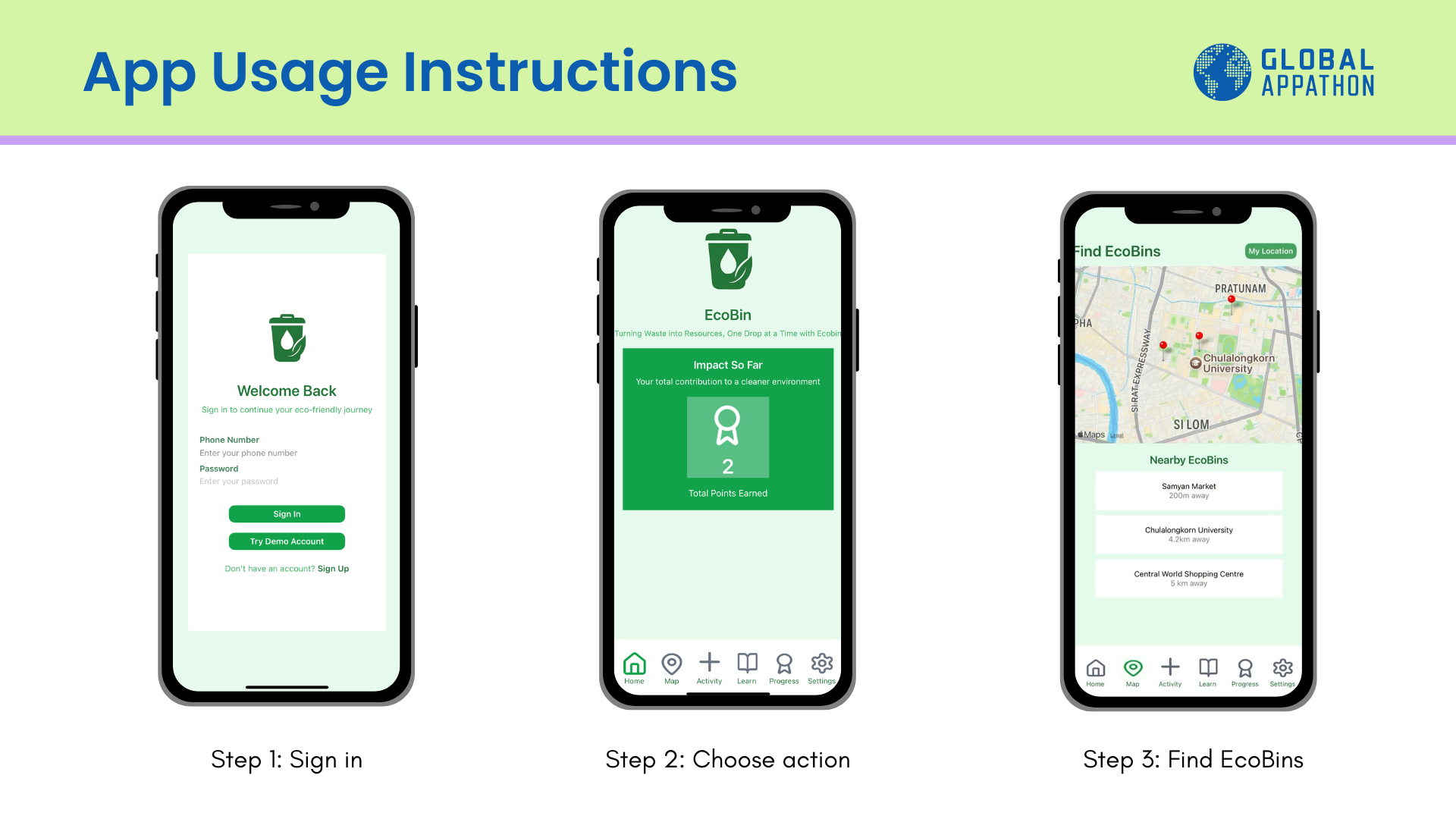
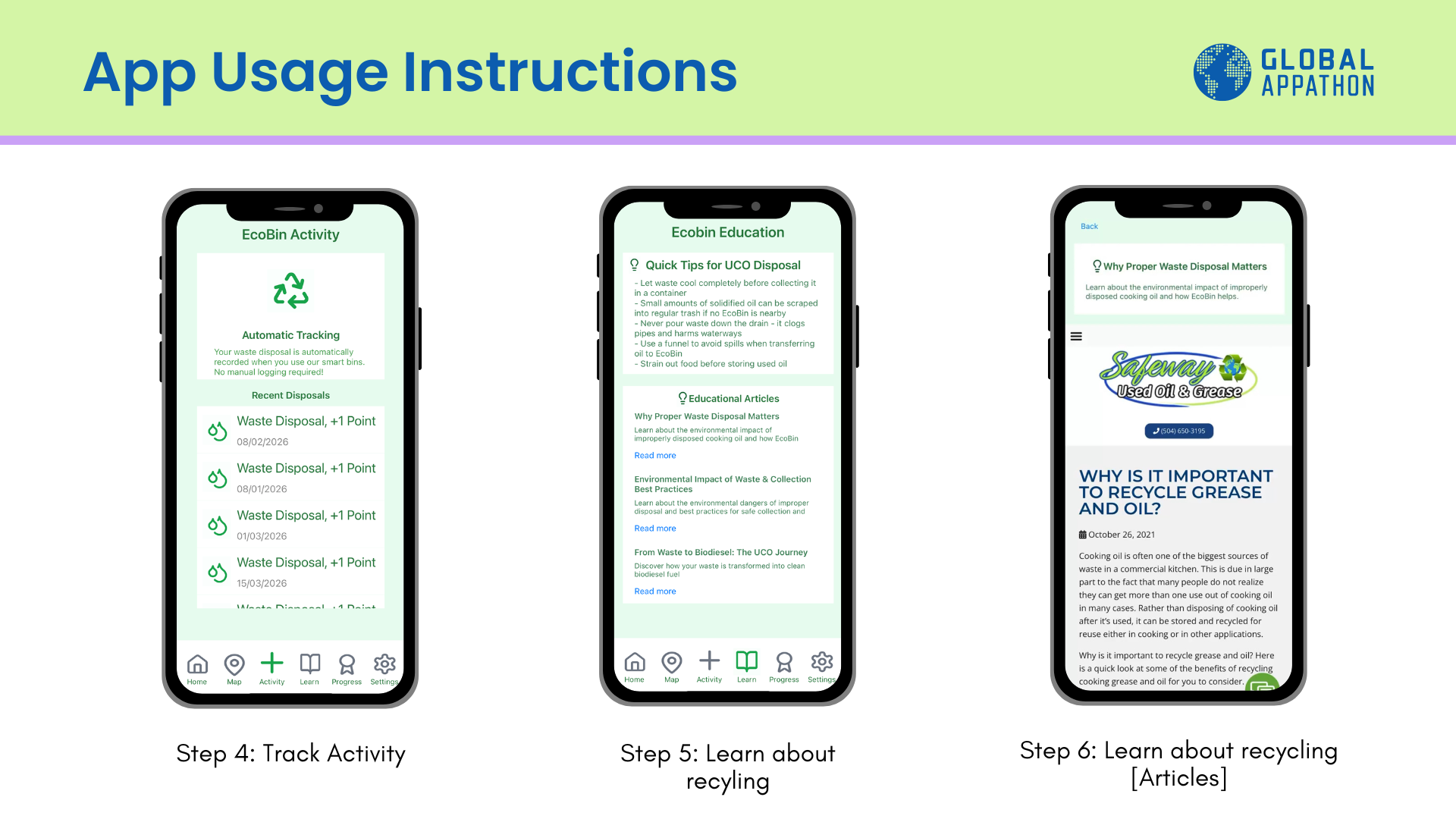
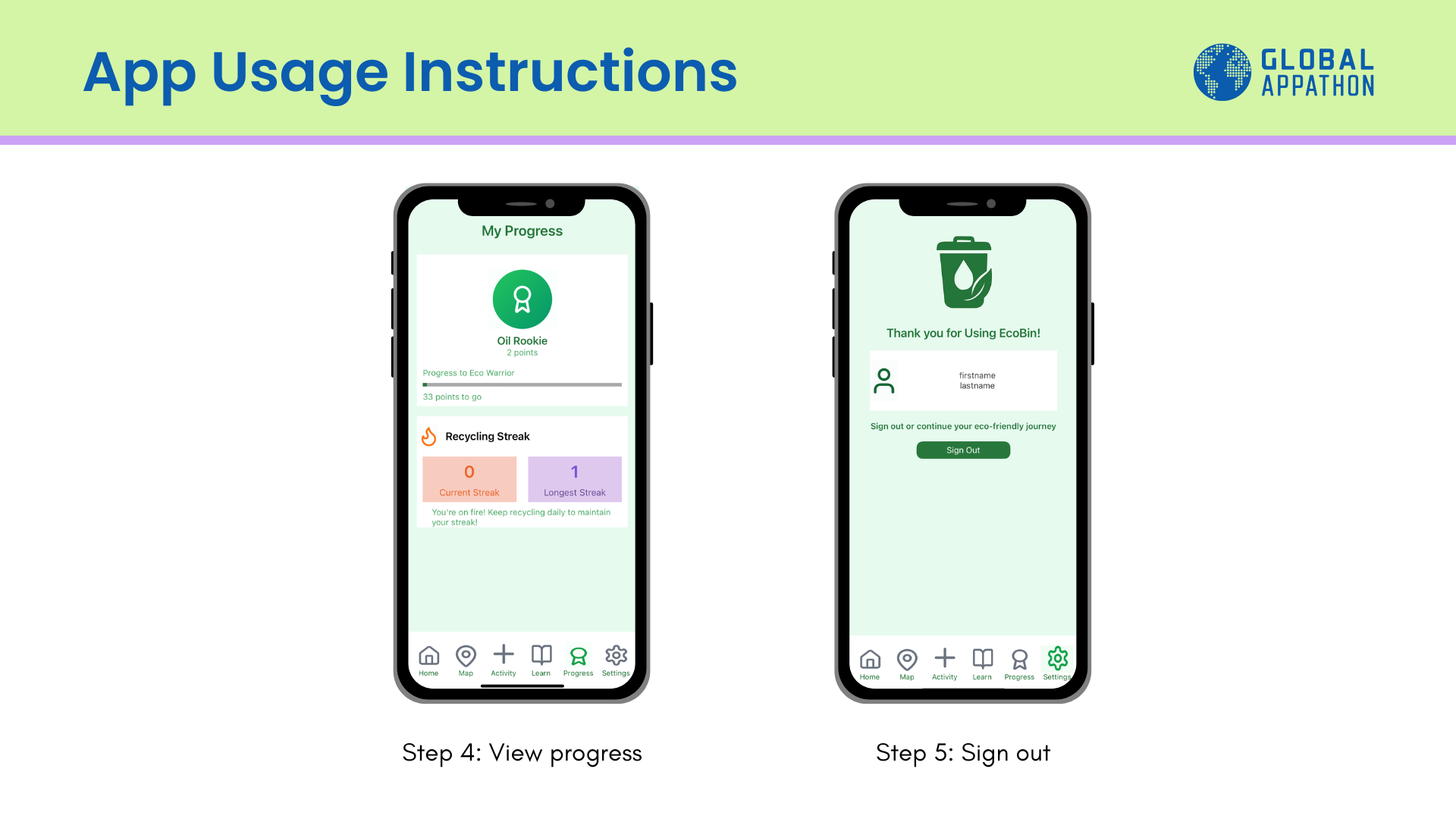
Alongside every kiosk, the EcoBin app and LINE Official Account let users find bins, track impact, and redeem points — turning a good habit into an ongoing relationship.

📊

Track recycling history & progress

See exactly how much oil you've recycled and the impact it's had over time.

📍

Find nearby bins

Locate the closest EcoBin collection point wherever you are.

🎁

Earn & trade EcoBin Points

Turn recycling into donations or rewards through gamified incentives.

🌱

Learn about your impact

Understand how oil recycling protects water, air, and communities.

See the app in action

EcoBin app walkthrough steps 1 to 3: sign in, choose an action, and find nearby EcoBins on the map EcoBin app walkthrough steps 4 to 6: track your recycling activity and learn about recycling EcoBin app walkthrough: view your progress and sign out
Under the hood

An AI model built for real-world kiosks, not just the lab.

We trained a YOLOv11-cls image classification model on 1,162 public and proprietary images, then stress-tested it against two other model families before choosing what to deploy.

99.64%Model accuracy
51.5 FPS~4ms inference time
3–6×Faster than SSD-MobileNet & Faster R-CNN
99.74%F1 score

Why speed & cost matter

Users need real-time feedback the moment they pour — a slow model means longer waits and more misuse. YOLOv11-cls is also lightweight enough to run directly on a Raspberry Pi 5, so EcoBin can scale to households, schools, and communities without expensive GPU infrastructure.

Solving for real conditions

Used cooking oil has bubbles, dark spots, shadows, and uneven transparency that standard data augmentation doesn't replicate. We built custom "black bubble" overlays to mimic real conditions, so the model performs accurately outside the lab too.

Scale of impact

Small drop-offs add up to a very large difference.

60M–120M liters

of water prevented from contamination per EcoBin, per month

350 buses

could run annually in Bangkok on biodiesel from just 10% of recycled UCO

20 hours

an LED bulb could run from just 2 liters of household oil recycled per month

TAM
~$6.1B

Total Addressable Market
Global used cooking oil market

SAM
~$3.05B

Serviceable Available Market
Regions with improper UCO disposal (Asia ≈ 50% of global UCO)

SOM
~$30.5M

Serviceable Obtainable Market
Initial 1% EcoBin penetration of SAM

Small action, big impact

Try the EcoBin app now.

Find your nearest bin, start tracking your recycling, and earn rewards for turning waste into resource.